Facial Palsy China Knowledge Library
Anatomy of the Facial Nerve
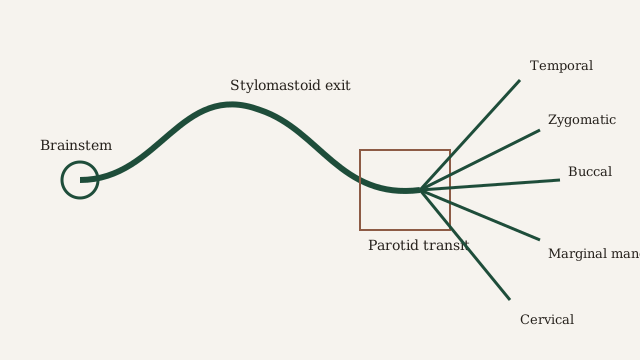
The facial nerve is the seventh cranial nerve. It leaves the brainstem, travels through the temporal bone, and exits the skull at the stylomastoid foramen. After that it runs through the parotid gland and divides into branches. Knowing that route explains why ear surgery, temporal-bone fractures, and parotid surgery show up in facial palsy stories. It does not let a reader point to a spot on a cheek and name the lesion.
This is educational information only, not medical advice. Always follow your clinician’s guidance.
What else the nerve carries
Besides moving the muscles of expression, fibers that travel with the facial nerve serve tearing, the stapedius muscle that dampens loud sound, taste on the front two-thirds of the tongue, and secretion from the submandibular and sublingual glands. Those jobs are why some people report a change in taste or uncomfortable sound along with a weak smile. NCBI’s anatomy chapter is the source for this summary.
Five branches, and the parotid
Beyond the parotid, the nerve is usually described as splitting into temporal, zygomatic, buccal, marginal mandibular, and cervical branches. The nerve passes through the parotid gland. It does not innervate the gland. That distinction matters when someone is reading a parotid operative note, and it is still not a home test of which branch failed.
Diagram
The drawing below is an original schematic for orientation. It is not a portrait of a patient and not a surgical map. Author: this library. License: original work of the library. Structures named: brainstem segment, stylomastoid exit, parotid transit, and the five terminal branches.
What facial palsy is. Trauma. After surgery
What the drawing cannot do
A line from the brainstem to five branches explains vocabulary in an operative note. It does not tell you which branch is weak, and it does not replace an examination. The nerve’s parasympathetic and taste jobs are why a history sometimes includes a dry eye, a loud sound, or a flat taste, but those clues are for the clinician who can test them.
The parotid relationship is the detail people most often reverse: the nerve runs through the gland and does not power the gland. Remembering that keeps a parotid operation from being described, wrongly, as surgery on the nerve’s target organ.